


Overview:
By Carolyn Christian
Each week, Signal Akron will help you in your gardening adventures with an excerpt from "The Root of It," a monthly newsletter from the Summit County Master Gardeners, Ohio State University Extension.
Ooooopossum. Oh dear. There’s a lot to sort out regarding this misunderstood and somewhat unnerving creature. Its name, for starters. A “possum” (Phalangeridae family) is a marsupial native to Australasia. An “opossum” (Didelphidae family) is out back rooting around your garbage can. But apparently “opossum” may be pronounced with the first syllable silent, so yelling, “Get outta there possum!” is correct. Good grief.
It’s hard to overlook its looks. Long greyish fur, black legs, a cone-shaped head, white face, beady little eyes — so ugly they’re cute?
Their 12-inch prehensile (capable of grasping) tail is a creepy but amazing tool for grabbing, climbing trees and hanging upside down. (Opossums climb trees but live on the ground). Sharp claws also help with climbing, but an opposable (moves like a thumb) clawless toe on each hind foot is really handy for climbing, feeding and grooming. But it’s also creepy.
You can’t tell by looking at them, but opossums spend a lot of time grooming, similar to house cats. Can’t blame ‘em for trying…
The opossum is not the only marsupial in North America (there are several in Mexico), but is the only one native to the U.S. The Virginia opossum (Didelphis virginiana) now ranges up into Canada and down into Costa Rica.
Opossums have been around since dinosaurs but are obviously much better adaptors than ol’ T-Rex. Scientists believe they are as smart as pigs, which are smarter than dogs (sorry, Fido). While preferring to reside in woody spots near water, low-maintenance opossums will nevertheless den almost anywhere — hollow logs, abandoned dens, garbage piles, rocks, storm sewers, under barns or sheds. They tend to be transient, but nevertheless furnish the den with leaves and plant debris gathered into a pile via paw and mouth, then carried via tail wrapped around it.

Their not-picky nature extends to their diet — they eat almost anything, including carrion (tastes like chicken). Opossums consume beetles, crickets, grasshoppers, slugs, snails and earthworms, birds, eggs and small mammals. They also forage in vegetation, trees, shrubbery, and your garden, your garbage can, your bird feeder, and Fido and Fluffy’s food bowls.
Scientists used to believe opossums ate tons of ticks (up to 5,000 a year), which really boosted their likes on social media. Too bad it turned out to be fake news.
Opossums also snack on snakes, including poisonous rattlesnakes, copperheads and cottonmouths. Scientists believe that as possums evolved, they developed a protein that neutralizes snake venom. These tough critters also have immunity to Lyme disease, scorpion and honeybee stings and botulism, plus their lower-than-most-mammals’ body temperature (94-97 degrees) deters the rabies virus.
Predators of opossums include fox, bobcat, coyote, raptors such as the great horned owl and gun-toting humans. Opossums often end up as roadkill due to their slow speed and propensity to hang out on roadsides dining on other roadkill (karma?). Opossums can live up to 7 years but generally don’t survive past their second birthday.
Being a marsupial means females have a marsupium (pouch to carry and nurse young). Breeding takes place from February to March, but can extend longer. Ohio opossums generally have one litter per year. Gestation lasts only about 13 days, and newborns are the size of a honeybee. These teensy joeys crawl to mom’s pouch, finding their way by smell.
Once there, they must attach to one of mom’s 13 nipples. Not all the nipples work, so this is baby’s first (and maybe last) time playing the lottery. Baby stays attached to the nipple for two months, then emerges for piggyback rides on mom, eventually leaving her for good between three and five months old.

During breeding season, females killed by cars often have live babies in their pouch; wildlife rehabilitators may be able to save the orphans.
Opossums are small and slow, so they need their full arsenal of defensive tricks. A threatened opossum will run (at 4 mph more of a fast walk), hiss, growl, bare their teeth, burp, or go to the bathroom. (Hopefully not all at the same time.) Although they may look fierce, they are not aggressive.
Famously, they “play possum” — rolling over and playing dead. But again, things are not what they seem. This “play” is quite real — an involuntary state that includes stiffening of the body, wide-open but unseeing eyes, protruding tongue, bared teeth, drooling and a very bad odor, all convincing evidence of death. A scared possum can remain in this catatonic state for six hours.
Like all wild animals, opossums carry diseases, and as hosts for ticks, fleas, mites and lice, they can transmit diseases carried by those visitors. So yes, opossums are a little scary. But some people find them adorable.
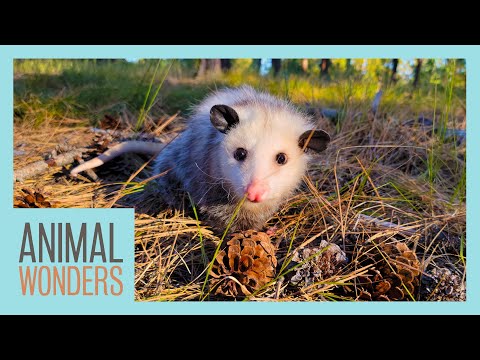
Creepy or not, opossums play an important role in the ecosystem as scavengers, prey, and seed dispersers. And given they’ve been around for 70 million years, they’re probably not going anywhere, so live and let live.
To encourage them to live elsewhere, read more here and here.